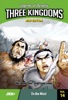
* Save 50% by grabbing volumes 16 to 20 in this exclusive omnibus edition!
Vol. 16: Western Shu stands. Now Liu Bei reaches for Hanzhong, the keystone between empires. Zhang Fei wins in the passes; Zhuge Liang seeks a commander who can finish the work. Up steps Huang Zhong--gray-browed, unbent, asking not for honor but for the hardest fight. In Wei, Cao Cao crowns himself King of Wei and sets Cao Pi as heir. As pageantry swells, reports from the front sour the wine: Huang Zhong wins vistory after victory. Sima Yi and Cao Pi advise caution; Cao Cao rides anyway. In Wu, Lu Su dies, and Lv Meng rises--only to point beyond himself, toward the future in Lu Xun. Knives flash; the succssion is secured.
Vol. 17: Cao Cao is so overwhelmed by anxiety and grief at the sight of Guan Yu's severed head. Cao Cao finds it impossible to believe that Guan Yu could succumbed to something as petty and human as death. But death is inevitable, and Cao Cao feels grief at seeing someone he admired reduced to mere lifeless body parts, but he also grieves for the way he has lost sight of the person he once was - an ambitious but idealistic young military commander and, prior to that a child wide-eyed at the wonders of the world.
Vol. 18: Guan Yu is dead. Cao Cao is gravely ill. And Liu Bei is consumed by vengeful rage. And suddenly the things they've spent their lives fighting for are in dangerous peril. Can anyone overcome fate to witness a final victory? Or will everyone go to his grave with unfinished business? Of the three rulers who remain, each has come to power in a unique wat: Cao Cao through ruthlessness, Sun Quan by virtue of inheritance, and Liu Bei because of his reliance upon and fidelity to those around him. In fact, the defining heroic act of Three Kingdoms is Liu Bei, Guan Yu, and Zhang Fei's blood oath, a selfless act that commits their individual lives to one another as well as to the cause of restoring China to its former glory. It is therefore ironic, but fitting, that the defining tragedy of Three Kingdoms stems from the same blood oath.
Vol. 19: The rivalry among Liu Bei, Cao Cao, and Sun Quan has been the defining struggle of the era of the three kingdoms. But two of the men are dead, and the era of the three kingdoms is drawing to a close. Now, Zhuge Liang, who was the architect of Liu Bei's ascent to power, must engage in almost constant battle and forge unpopular alliances if he is to preserve the legacy of his former master. Now that Liu Bei is gone, a very unexpected truth reveals itself: that as much as Liu Bei's passionate dream depended on Zhuge Liang's shrewd tactics, those tactics alone cannot achieve the dream unless paired with a similar passion. Only after it's too late does Zhuege Liang realize that he needed Liu Bei as much as Liu Bei needed him. The problems are apparent soon after Liu Bei dies. Where once he could call upon advisors and generals who shared Liu Bei's dream, Zhuge Liang now finds himself surrounded by a new generation of men, most of whom have no memory of the Han Dynasty that Liu Bei fought so hard to restore.
Vol. 20: Years grind by. The two great minds trade salvos; soldiers die in the stalemates that move no boundary or banner. Zhuge Liang springs a final design, tricking Sima Yi and chasing his forces into Shangfang Valley--where an ambush waits to end the war once and for all. But fate ends it first. Illness takes the Zhuge Liang as the trap closes. The signal does not come, Sima Yi survives, and the war he would not fight becomes the victory he can claim. In 263 AD, the King of Shu Liu Shan surrendered to Wei. In the next year, Sima Yi's grandson Sima Yan ascended to the imperial throne to found West Jin. In twenty years, Sun Quan's grandson Sun Hao, the King of Wu, surrendered to West Jin, and division that raged throughout the continent for such a long time finally ended.